
Signs of a Failing Drain Field
The common signs of a failing drain field are slow drains across the house, soggy ground or standing water over the lines, sewage smell outside, and grass over the field that is greener than the rest of the yard.
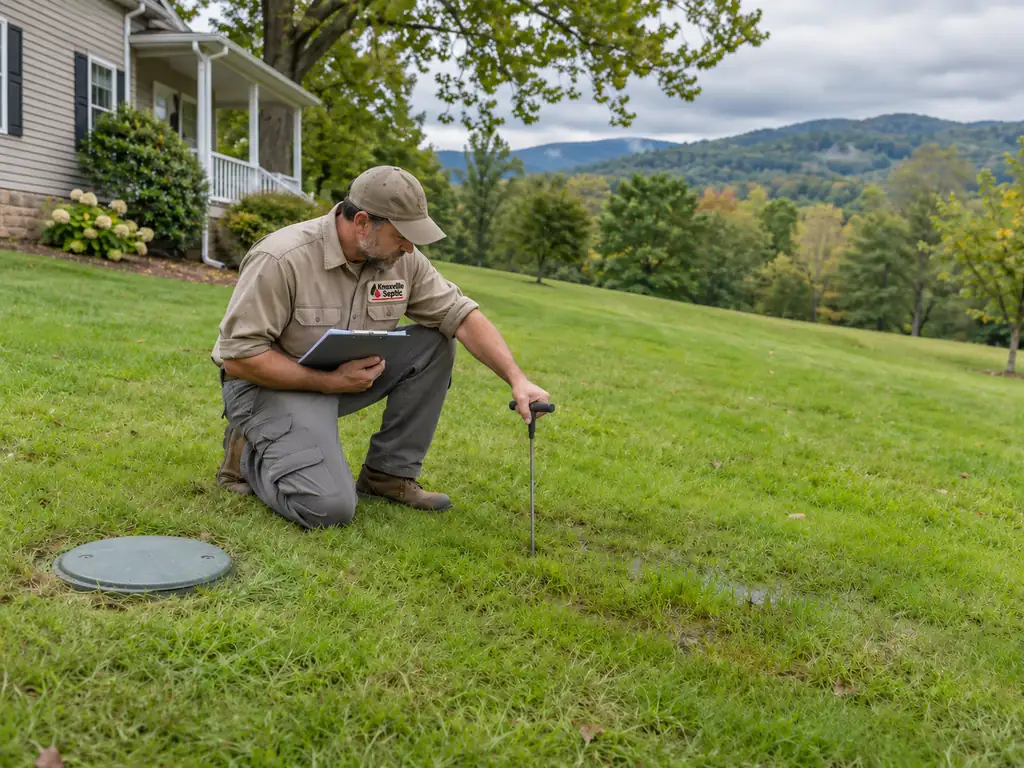
The signs, from earliest to worst
- Drains that are slower across the whole house, especially after heavy use or rain.
- Gurgling pipes.
- Ground over the field that stays soft or wet days after rain, or stripes of greener grass along the trench lines.
- A sewage smell in the yard.
- Gray or black water standing on the surface.
- Sewage backing up into the lowest drain in the house.
The early signs are easy to put down to the weather. Spring is when most failing fields around here give themselves away, because the ground is already full of water.
Full tank or failed field?
The symptoms overlap, so the tank is the place to start. Once it is opened, the liquid level tells most of the story. In a working tank the liquid sits level with the outlet pipe. If it is well above the outlet, water is not getting away, and the problem is the outlet, the line beyond it, or the field.
If the tank simply had not been pumped in years and the symptoms clear up after a pump-out, the field may be fine. If the tank refills and the yard goes soggy again within weeks, the field is not taking water. One slow fixture on its own is usually just a clogged pipe inside the house.
Why clay fields fail differently
Every drain field grows a thin layer of slime, called a biomat, where the effluent meets the soil. On sand, water still gets through it easily. On clay the soil was slow to begin with, so the biomat can seal it.
The clays weathered out of East Tennessee limestone also swell when wet and shrink when dry. That opens cracks in dry summers and closes them in wet winters, so a marginal field can seem fine for months and then fail all at once in March. Shallow rock and seasonal wetness on some lots leave even less soil to work with.
In Knox County
Knox County clay takes water slowly and swells when wet, and searches for septic help roughly double from February to March as spring rain saturates the ground. That is when weak fields show it.