
What to Do If Your Land Fails a Perc Test
If your land fails a perc test, find out exactly why it failed, then ask whether an alternative system can work: Tennessee approves low pressure pipe, drip and mound systems for soil that cannot take a conventional drain field.
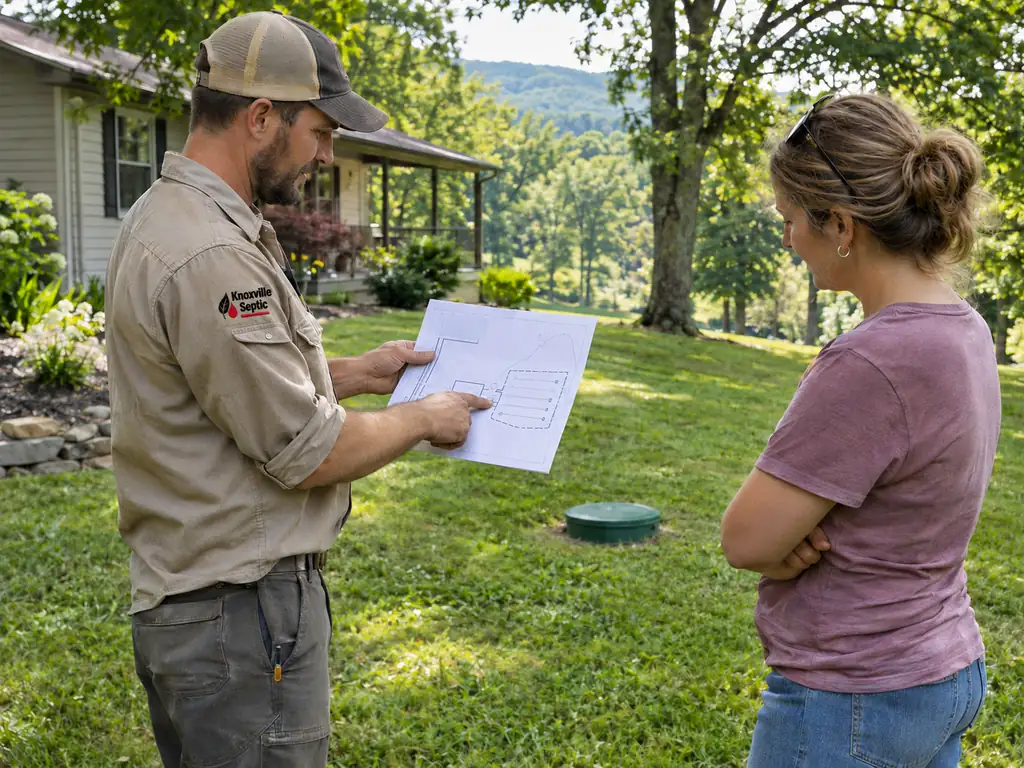
Why land fails a perc test
A lot fails when the soil cannot safely take and clean the water from a conventional drain field. Under Tennessee's rules the usual reasons are:
- Soil too slow. A conventional system needs soil that absorbs at 75 minutes per inch or faster. Heavy clay is often slower.
- Soil too fast. Faster than 10 minutes per inch, the water reaches groundwater before the soil has cleaned it.
- Rock or water too close. Both normally have to be more than 4 feet below the bottom of the field.
- Slope. Over 30% is usually unsuitable.
- Sinkholes, drainage ways or a wet area where the field would go.
- No room for a reserve field alongside the first one.
The notice you get from the permit office says why the site was turned down. Start there.
Can you build on land that doesn't perk?
Often, yes. Tennessee's rules approve several alternative systems for sites that cannot take a conventional field:
- Low pressure pipe (LPP). A pump doses the effluent through small pipes in shallow trenches. It needs at least 30 inches of soil above any restrictive layer, and can work on slower soil than a conventional field, as long as wetness is not the problem.
- Drip disposal. The effluent is treated first, then dripped through tubing just below the surface. The state requires a maintenance contract for the life of the system.
- Mound system. The field is built up above the natural ground.
- Lagoon. Only on large lots: at least 5 acres, set back 200 feet from the property lines.
Every alternative system needs an extra-high intensity soil map from a state-approved soil consultant, and the state permit fee is higher: $500 instead of $400.
If no system can be permitted, the house cannot go in. Tennessee requires proof of a septic permit application or a sewer connection before a house is placed.
What an alternative system costs
More than a conventional system: there is a pump, more design work and a more detailed soil map, and drip systems add treatment and a maintenance contract. Set the system type on the septic installation cost calculator to see the difference for your house.
As a rough guide for a three-bedroom house in this area, a low pressure pipe system typically runs $15,000 to $25,000, a drip system $20,000 to $35,000 and a mound $25,000 to $40,000. These are estimates; your soil report and site set the real figure, and we confirm it with you before any work starts.
If you are buying land
Get the soil evaluated before you close, and write the result into the contract as a condition of the sale. A septic permit is good for three years from the day it is issued, so a permit already on a lot you are buying may be close to expiring. If the ground has been graded since the evaluation, it has to be evaluated again.
Helpful answers
Questions people ask
Can you build on land that failed the perc test?
Often, yes. If the soil cannot take a conventional drain field, Tennessee allows alternative systems such as low pressure pipe, drip and mound systems, each designed from a detailed soil map. If no system can be permitted and there is no sewer, the house cannot be built.
In Knox County
Most of Knox County is red clay over limestone, so the usual problems here are slow clay, shallow rock and sinkholes. Knox County runs its own septic permit office, so a failed evaluation on a Knox County lot comes from the county, not TDEC.